Advocacy in Action for Water and Wastewater
by Allison Smith
This article was published in the Spring 2026 issue of our newsletter.
Legislative advocacy is becoming an increasingly important part of water and wastewater roles. In the absence of operators telling their stories and sharing their expertise, important legislative, regulatory, and funding decisions can be made without the critical information and lived experience that only working in the industry can provide.
In December, the Vermont Rural Water Association held its second annual gathering of mentors and apprentices, and the focus was on building advocacy skills.
Karen Horn, who works closely with the Green Mountain Water Environment Association on legislative advocacy, provided an overview of the state-level legislative process. Apprentices and mentors then took part in a mock committee hearing centered on House Bill 286, which addresses conservation and development, water supply, maximum contaminant levels, and PFAS. Participants stepped into roles such as committee chair, community advocates, environmental experts, state staff, and water and wastewater operators. The goal was to give attendees the experience of how committee hearings work and to build confidence in speaking up on issues that directly affect the industry.
The afternoon session expanded the conversation to include decision makers. The group was joined by Bryan Redmond and Ben Montross from the Vermont Drinking and Groundwater Protection Division, Heather Collins from the State of Vermont Wastewater Program, and Morgan Nichols from the Office of Representative Becca Balint. Apprentices and mentors shared both the opportunities and challenges they experience in the industry and offered practical insight into what would best support operators and systems across Vermont.
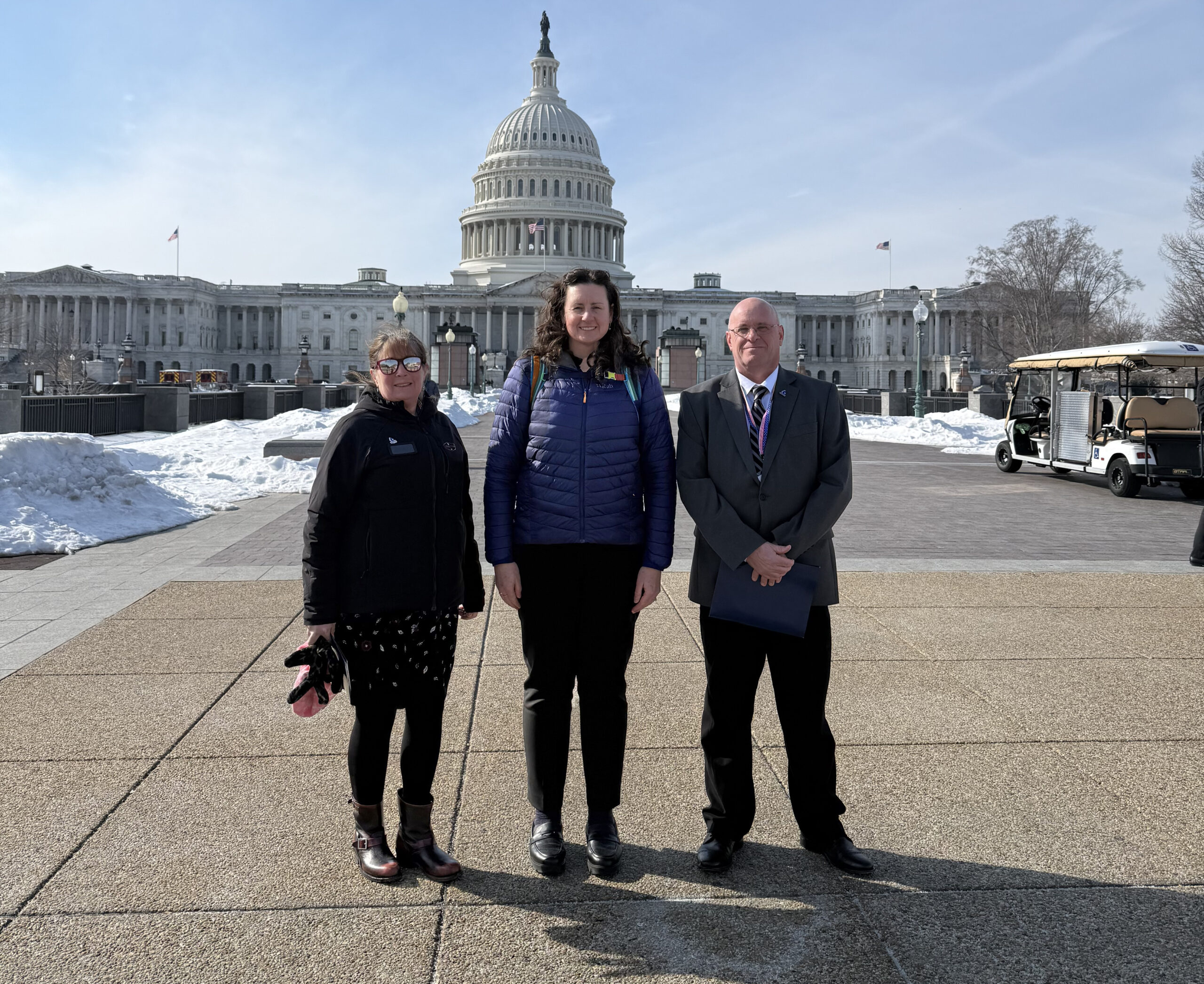
Left to right: Margaret Dwyer, Allison Smith, and Jon Thornton at the Capitol building in Washington, D.C.
For a few of us, advocacy efforts also extended to the national level through participation in the Rural Water Rally in Washington, D.C. in February. I attended the Rally alongside Vermont Rural Water board members Margaret Dwyer and Jon Thornton.
Each year, the National Rural Water Association asks Congress for federal funding through USDA, EPA, and DOL. These funds benefit small, rural water and wastewater systems through grants, loans, and technical assistance.
During the Rally, we met with all three offices of Vermont’s federal delegation—Senators Sanders and Welch, and Representative Balint—to request continued funding for Rural Water programs. Our conversations focused on the need for full funding of the State Revolving Funds, cybersecurity concerns, flood and drought resiliency, and workforce challenges. Vermont’s delegation showed strong support for our work and a clear understanding of the realities faced by small and rural water and wastewater systems.
There are many ways to get involved in advocacy for both the water industry and your own system. If you are interested in learning more about how you can help share the most critical challenges, needs, and successes of the water and wastewater sector, please reach out. We are always happy to connect you with opportunities to make your voice heard.