

by Elijah Lemieux
This article was published in the winter 2025-26 issue of our newsletter.
Public works employees regularly interact with the community, sometimes in situations that can become tense, emotionally charged, and potentially unsafe. Who among us hasn’t dealt with an upset customer, been in a stressful situation with a coworker, or had to break some bad news to local leaders?
Vermont Rural Water recently hosted a training class on verbal de-escalation to teach water and wastewater operators communication strategies to navigate difficult situations and maintain trust and respect between public employees and the communities we serve.
The class, De-Escalating High Intensity Situations, was taught by Mourning Fox, LCMHC, the Director of Mental Health Programs for the Vermont Department of Public Safety. He leads trainings like this for law enforcement personnel and social service staff.
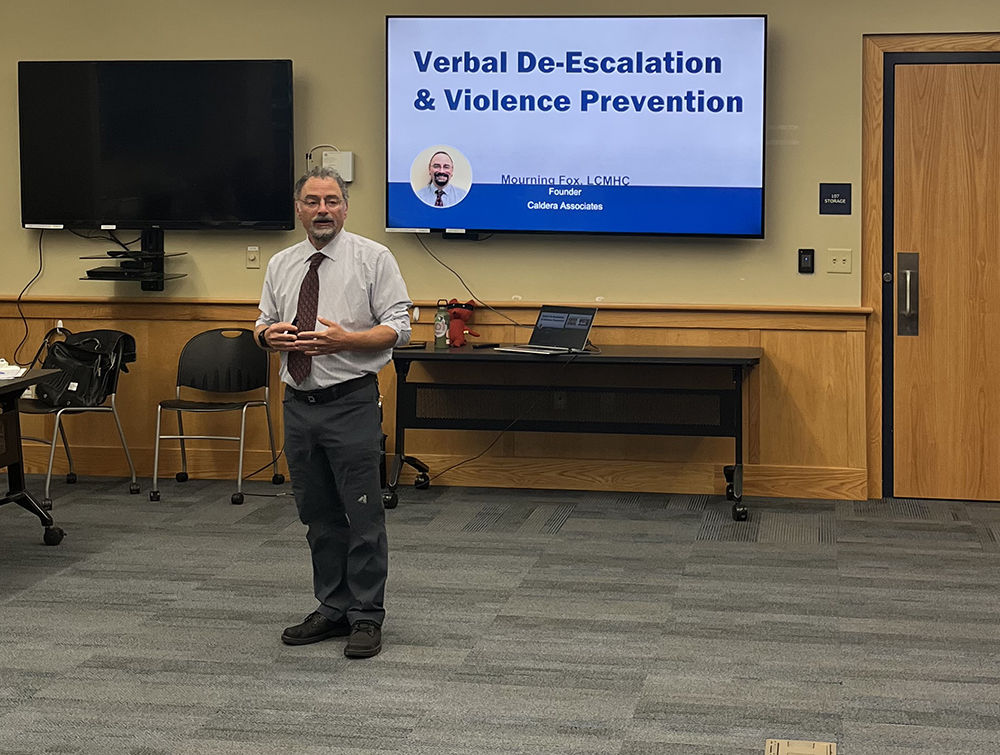
Mourning Fox taught De-Escalating High Intensity Situations in September.
I, somewhat begrudgingly, attended the class at my boss’s (Liz Royer) suggestion. I was dreading the idea that the training would involve role-playing some made-up situation, something that the mere thought of makes me cringe.
At the very onset of the training, Fox began by telling us there would be no quiz or test and there would be no role-playing. I was relieved and I suspect others in the room may have been too, and this was no accident—it was the first lesson.
Fox explained that he likes to give his audiences an overview of what they can expect from the training. This is because having the “unknowns” identified and addressed helps make everyone more comfortable, and therefore better able to learn. I know that I was relieved and more able to focus once I knew I wasn’t expected to act out a scenario.
Not only did Fox give us strategies to make people more comfortable, but he also gave insightful explanations for why people act the way we do. If I tried to summarize all of Fox’s presentation I wouldn’t be able to do it justice, so the next time we offer this class, I highly recommend you sign up for it yourself.
Verbal de-escalation skills can help you:
- Prevent confrontations from escalating into dangerous situations
- Reduce tension and build trust with community members
- Maintain professionalism and represent your municipality or organization positively
- Help prevent your workplace from becoming a hostile environment
In the meantime, I will relay some of Fox’s insights in hopes that you may find them as useful as I did:
• Acknowledge and address the unknowns. Fox did this for us by making it clear that the class wouldn’t involve role-playing exercises. Water and wastewater operators could do this by explaining to customers how long a repair will take, how long water will be shut off, and where customers can get drinking water in the meantime.
• Avoid words that minimize someone’s experience, like “just” and “only.” Consider, for example, if you told a coworker, “You just need to try again.” If the first attempt was challenging, then trying again is not just so easy. Using carefully chosen words can be the difference between de-escalating a situation or escalating it.
• “You need to” is another phrase that can be triggering. Telling someone that they need to do something could make them less likely to do what you want. Telling someone “You need to calm down” is not going to make them feel calm.
• Recognize other people’s values. It’s easier to respect others, even when you disagree, if you can figure out what they value. Their values may be different from yours but are equally valid. For example, if someone is upset because you need to dig a hole in their lawn to make a repair. You might think, “It’s just grass, it’ll grow back.” But if they value the aesthetics of their property, then a hole in the lawn is going to be upsetting to them.
Through respect we build rapport, through rapport we build relationship, through relationship comes influence, which helps us get to successful resolutions.
• Build relationships. When we build relationships with the people we interact with, we develop mutual respect, which allows us to bestow more grace upon each other when we disagree. This is important with coworkers you see daily, municipal leaders you interact with occasionally, and even community members you only meet once.
• Avoid judgment. One of the most important parts of Active Listening is to use a non-judgmental attitude. If someone feels judged, they will not feel comfortable enough to continue discussing until the issue is resolved.
To summarize, your words and actions affect your interactions. You have the power to escalate or de-escalate any situation.
Following the training, a number of us commented that these skills might be helpful to us in our parenting and other areas of life outside work. I felt that this was one of the most useful trainings I have attended and wished that there was a second day of class to dive deeper.