
by Allison Smith
This article was published in the fall 2025 issue of our newsletter.
When Brian Murray first started working for the Town of Middlebury’s water system, he did not know just how much it would shape his career or how soon he would become someone others look up to. After completing his water treatment apprenticeship through Vermont Rural Water’s program, Brian has now taken on a new role: mentor. Following recent staff changes in Middlebury, Brian is now the Lead Operator and quickly stepped up to help train the next apprentice, passing on what he has learned and ensuring the system keeps running smoothly.
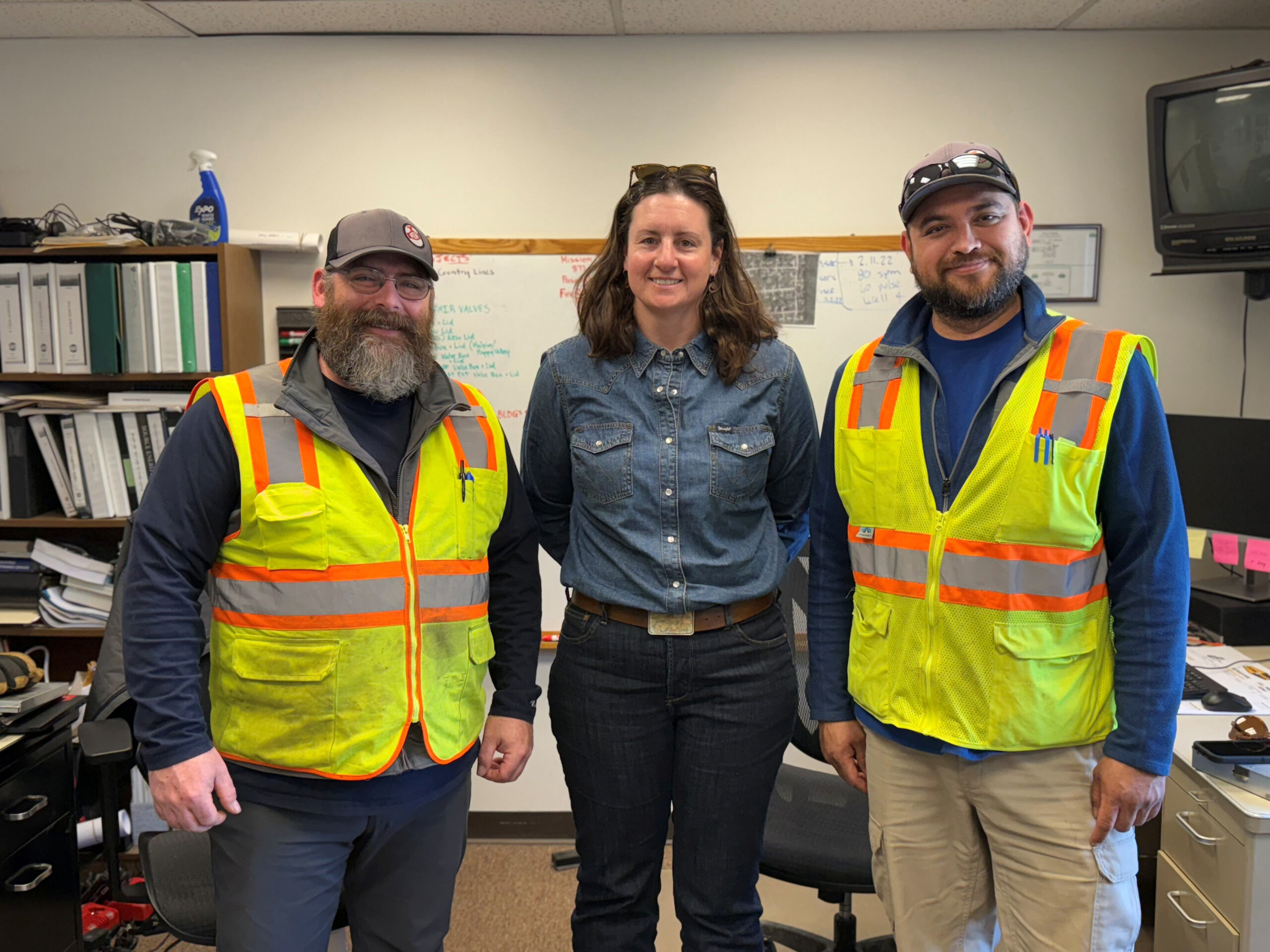
Left to right: Brian Murray, Allison Smith, and Alberto Trujillo
During his own apprenticeship, Brian said that strong mentorship from the Middlebury team made all the difference. His mentors, former operators Heather LaDuke and John Trombley, created an environment of rigorous learning, encouraging Brian to master the system’s complexities, and take initiative over his learning. John gave Brian the confidence to “sail his own ship” while assuring him that he would not be left to fail. Heather drilled him on system details and had him walk transmission lines, get involved with mapping, and jump into hands-on components of the job, like learning about complex valves.
Support from Vermont Rural Water’s apprenticeship program was also key. The structure of the program, including classroom instruction, preparation for the certification exam, reading materials, and guidance from apprenticeship coordinator Paula Jackson, provided a solid foundation that helped Brian succeed. Vermont Rural Water continues to be a support now that Brian is leading Middlebury’s Water Division. Brian said, “Paula has been phenomenal in thinking through situations and troubleshooting when issues in the water system arise.”
Now, just a few years later, Brian finds himself on the other side of the apprenticeship program, mentoring Middlebury’s newest apprentice, Alberto Trujillo. He remembers that initial feeling of being overwhelmed and is determined to provide the same level of support and encouragement that he received. Brian is intentional about providing hands-on learning experiences and takes pride in watching Alberto’s skills and confidence grow. “Training Alberto has been a pleasure,” Brian says. His mentorship philosophy can be summed up in the statement, “There should be no secrets among the team, and everyone should be trained the same way, knowing the same things. That way everyone is an equal.”
When asked what advice Brian would offer to other systems considering taking on an apprentice, he feels strongly that the mentor must be patient and willing to communicate. Brian makes an effort to include Alberto in all the conversations and experiences of being an operator, from sampling to making repairs to purchase orders. He also emphasizes the importance of providing time for apprentices to study for certification exams during the workday, even if it means taking on extra work himself in the short term. Brian also believes that laughter and camaraderie are essential parts of building a strong team.
One of Brian’s proudest moments as an operator came during a crisis in January 2024 when a water hammer caused 33 water main breaks in Middlebury. Brian worked 50 hours straight to restore service, resulting in only two service lines needing a boil water notice. “Knowing there were people, a hospital, and businesses counting on me kept me going,” he said.
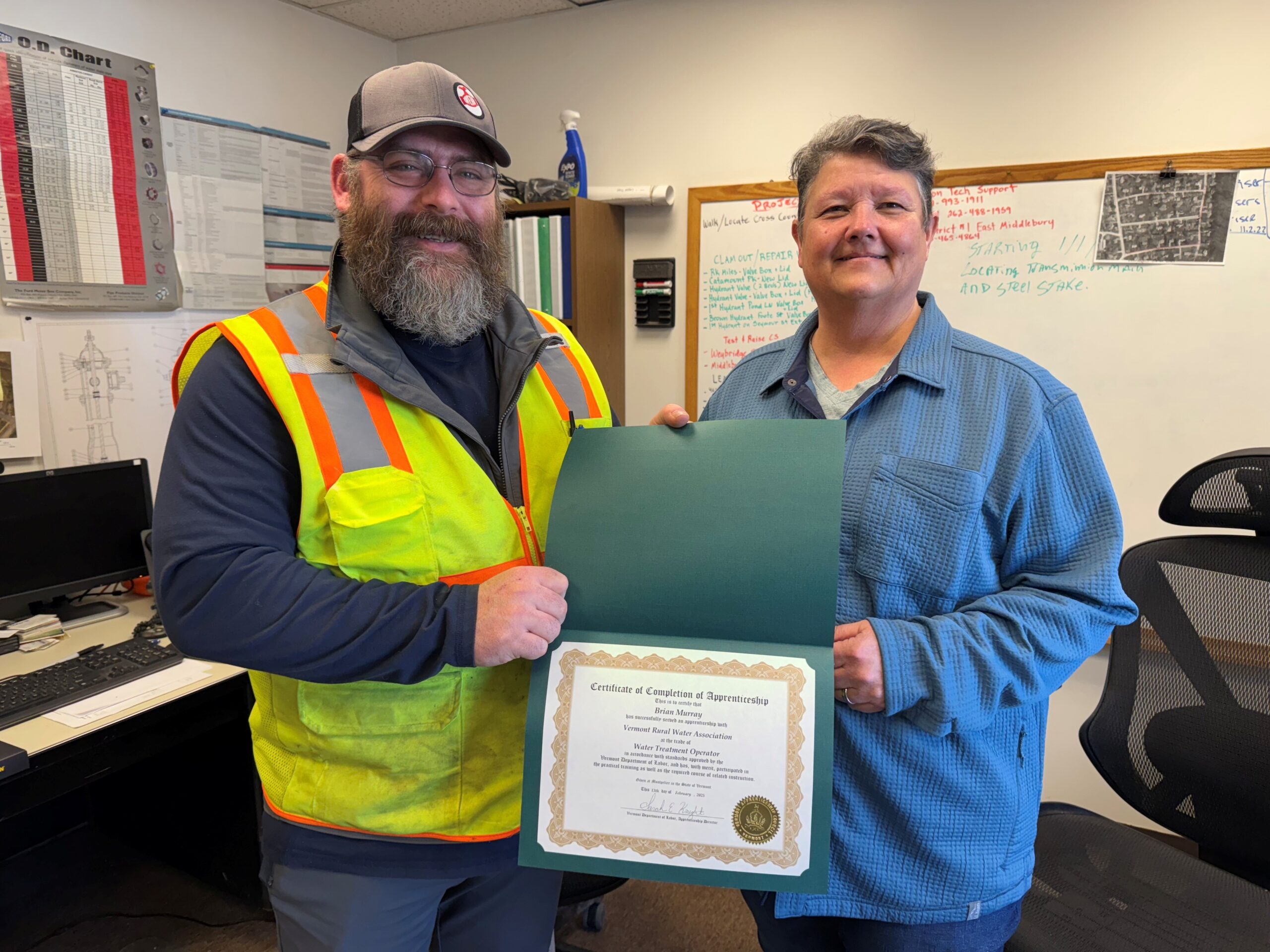
Brian Murray and Paula Jackson with a certificate honoring
Brian’s completion of the apprenticeship program.
Brian’s path to the water industry was not a direct one. He spent years working for D&M Petroleum handling tank removals, pumps, piping, and tank monitors. He then moved to a maintenance position at Woodchuck Cider. There, he worked the night shift, applying his hydraulics knowledge and working with programmable logic controllers (PLCs). When a job opened with Middlebury’s water department in 2022, Brian jumped at the chance. The regular hours, retirement benefits, and opportunity to work locally were appealing, as was the essential role that he would play in the community. In many ways, the work was not so different from his past roles. Working in water is still about moving fluids, just on a much larger scale.
Beyond the day-to-day, Brian was drawn to the water industry because of its importance to public safety. He acknowledges the responsibility that comes with providing clean, safe water but says he is not intimidated by that aspect and feels prepared because of his years working with petroleum, which can be a volatile and risky substance. “It’s my duty to keep the water flowing and make sure it’s good, clean, healthy, safe water,” he said.
Brian takes great pride in operating Middlebury’s water system. It serves not only the town’s residents but also businesses, dairy farms, a hospital, retirement communities, and Middlebury College. The system spans 54 miles of pipeline, with infrastructure dating from 1901 to the present day, and a blend of soil types ranging from gravel to clay. Its largest well, which is referred to as Palmer’s Springs, was established in 1965 and can produce 1,550 gallons per minute. Due to the well’s generous flow and the sizing of pipe on the system, pressures regularly register above 120 psi. For Brian, the uniqueness and complexity of the system make the work both challenging and rewarding.
Brian is always looking to the future and is excited about major projects that will improve the resilience of Middlebury’s water system. A recently approved bond will fund the construction of a new reservoir, increasing storage by 1.3 million gallons, which is enough to sustain the system for four to six days if the main well goes offline. He also hopes to replace the aging 1965 manual propane generator at the Palmer’s Springs Well with a modern automated system, ensuring reliability for years to come.
Although the public does not often see the complexity and planning behind the scenes, Brian says it is all worth it when someone stops by during a curb stop repair just to say thank you. That recognition is a reminder that “there are people who do appreciate what we do.”
If you would like to learn more about getting involved with the apprenticeship program, you can find more information at vtruralwater.org/apprentices