by Aaron Perez
This article was published in the Summer 2026 issue of our newsletter.
I was first introduced to dowsing for water utilities by Tom Anderson, who was a long-time operator for the Town of Windsor when I met him in 2008. I learned a lot of valuable things from Tom when I began at Vermont Rural Water, but when he brought out a pair of copper rods to locate a plastic water line, I was skeptical, though intrigued.
After walking a grid pattern over the property, sure enough the two rods he held pointing straight out turned in and crossed each other. Tom marked the spot and continued to repeat the process until a water line had been marked out. At that point I was still pretty skeptical. Where he marked the line did not make a lot of sense in relation to where I would have expected it to be, a fairly straight line to the main.
Well, I got out my metal detector and went over his marks with it, and sure enough within about a minute I got a good hit from the detector. After a little digging, there was a curb stop. Tom had been dead on with his marks. He proceeded to explain to me that you really had to concentrate on what you were looking for and believe that you can find it. Good advice for dowsing and life.
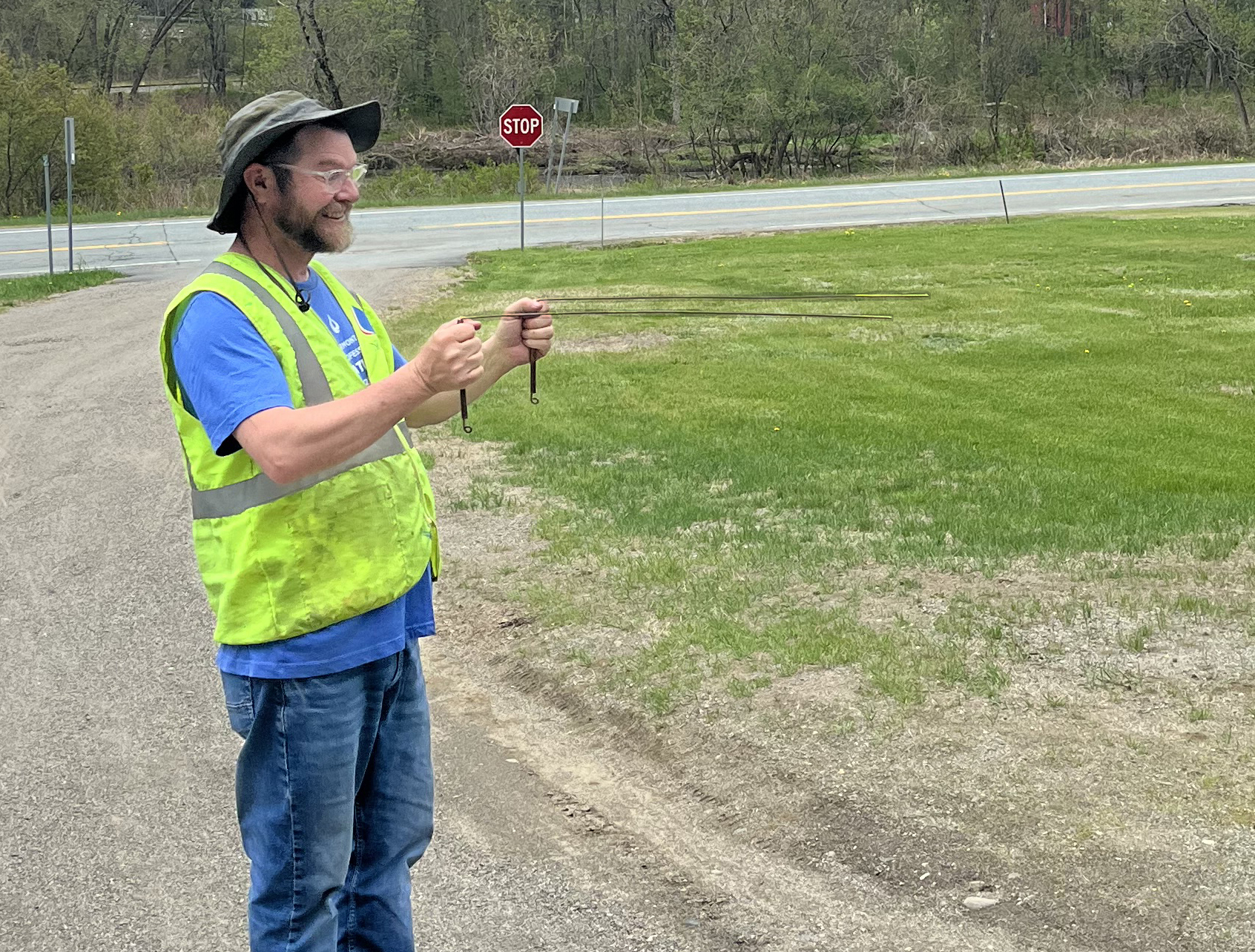
Aaron Perez holding dowsing rods.
After I got home that day, I went to the house of a neighbor who was a welder. He gave me two long welding rods that I bent into my first pair of dowsing rods.
Dowsing has been used in some form since ancient times and has been used around the world to find water, minerals, and objects. I looked online and asked everyone I know who dowses to find a definitive explanation for how and why it works. I read and heard a lot of theories, such as the pull of a person’s magnetic field to water or tapping into a vibration of the thing you are looking for.
I have no idea myself as to how it works, but in the case of water dowsing, I suspect we are drawn to water like the tides to the moon, which I know is as vague as the other explanations.
I also looked for articles about dowsing being used in water distribution systems and found very little. I know that the practice of dowsing to find water sources is still commonly used in Vermont and I am sure many other places, but I have not seen it used often in the water distribution world.
I use my dowsing rods when it is not feasible to use the other modern equipment I have in my toolbox, and I have had good results over the years. I can often dowse for a line and then verify its location by identifying associated valves. I have also located lines though dowsing that have then been verified during excavation. My success rate with dowsing is good but certainly not one hundred percent. What I can say is I have had many more successes than failures over the years. I can also say the same thing about locating lines with modern equipment.
With any equipment, there are always variables when doing underground location. Ground conditions such as moisture and soil type, as well as other utilities in the area, can all affect the equipment’s abilities and accuracy.
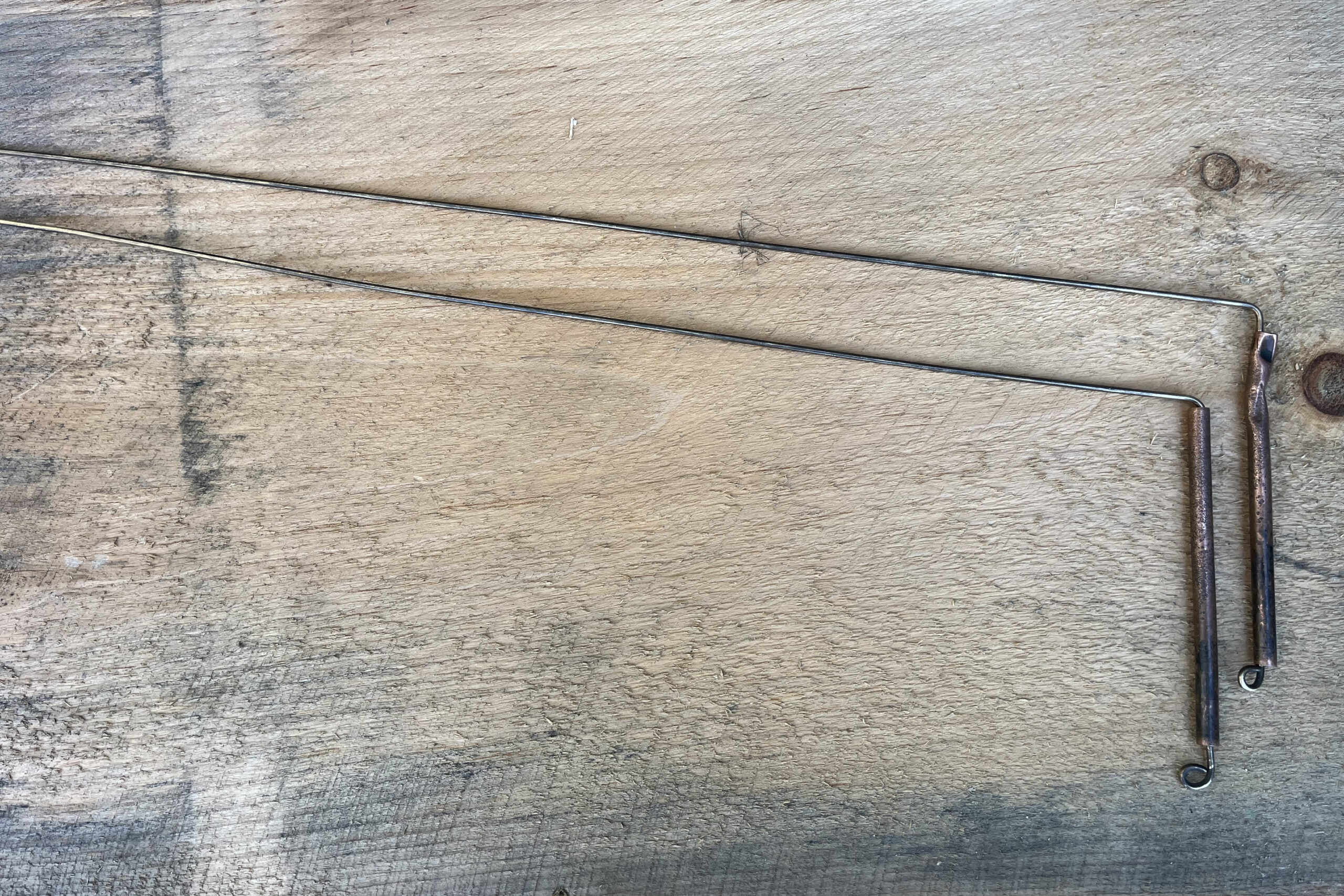
The dowsing rods Aaron received from Tom Anderson.
It seems that almost all the operators I work with know someone who dowses, or dowse themselves, and like all things discussed with operators, everyone has a story and an opinion about it.
Here is one of my stories. I was looking for a leak in a small system that had a mix of pipe material. The leak was elusive and the suspected line was a long stretch of plastic pipe. After a day of searching and dowsing, we had located the line but not found the leak.
We were trying to figure out our next move when a friend of the operator mentioned that he had dowsed wells and would be willing to try to dowse for the leak. Well, I was very excited to see if this would work. Although I have been able to locate a lot of pipes, I have never been able to dowse a leak.
The next day the operator and his friend went out to give it a shot. I heard later that day that the friend had indeed identified a spot that could be the leak.
After some excavation, they had a hole with water pouring out, which seemed promising. However, digging a little further they found the pipe—intact with no leak. It was a spring producing the water. So you could say that the dowsing did not work and we got lucky on finding the line. Or, you could say the dowsing did work because we did find flowing water—it just wasn’t the water we were looking for.
We did find the leak a few days later, but it was through persistently exhausting all possibilities and using every method available. So whether it be modern technology or older methods, there are no sure things, but believing that you can find what you are looking for will always help.
When Tom retired a few years ago, he gave me his set of dowsing rods. Although it is the simplest tool at my disposal, it is also the one I never show up to a job without.